

The newsletter was a disaster.
Nobody was reading it. Sales didn’t know what features had launched. Customer success was finding out about production issues after angry customer calls. The CTO pulled Antonia Landi aside and asked her to condense the massive update into three sentences for the board.
To Antonia, the solution was crystal clear. They needed a complete communication strategy overhaul. An inventory of communication artifacts. A framework for what team needed what information, at what cadence, in what format.
She told them: we need to overhaul absolutely everything.
How it landed: “The first thing she does is tell us that we need to throw everything out the window.”
To Antonia, it was obvious. To the team who’d built that system, who lived in it daily, who’d grown accustomed to its quirks, she was the brand new leadership hire telling them on week three that everything they’d built was wrong.
“Undoing the fallout of that,” Antonia reflected years later, “took way longer than taking them on that journey would have been to begin with.”
That moment, which she describes as one of the biggest mistakes of her career, planted a seed that eventually grew into a framework, a manifesto, and a body of hard-won pattern recognition about what kills ProductOps momentum before teams even realise they’re stuck.
“Product operations enables product excellence. And it must be pragmatic.” - Antonia Landi
💡Product Circle⭕ Chat runs every second week as a Zoom call that anyone can join to talk all things product, product management and problem solving. Creating value for customers and the business.
Best of all, when you attend live, you receive goodies like free courses and decks (like Janna Bastow provided), a free book (like Rich Mironov, Roman Pichler and others provided), access to their course for free (like John Cutler provided) and many more.
Don’t forget to follow the 💡Product Circle ⭕ Chat calendar on Luma and register for our next live chats on
💡 Product Circle ⭕ Chat - The 4 Principles Behind Every Successful Product Culture with Joca Torres on 1 July
💡 Product Circle ⭕ Chat - Beyond Vibe-Coding: How Evidence-Guided PMs Win with Itamar Gilad on 15 July
💡 Product Circle ⭕ Chat - You’re Not Funding Ideas. You’re Funding Assumptions. with David Bland on 31 July
👋I’m Irene Liakos. A product management, change, AI and growth expert with over 2 decades of experience growing product profitably across Telco, Banking, Fintech, AI, Data, Travel, Ecommerce and more. I teach, coach and advise product managers and business leaders. Reach out to me if your products aren’t delivering the value you need. You can contact me at irene@phronesisadvisory.com
Now don’t miss an article, make sure you subscribe!
Let’s get back to Antonia’s talk.
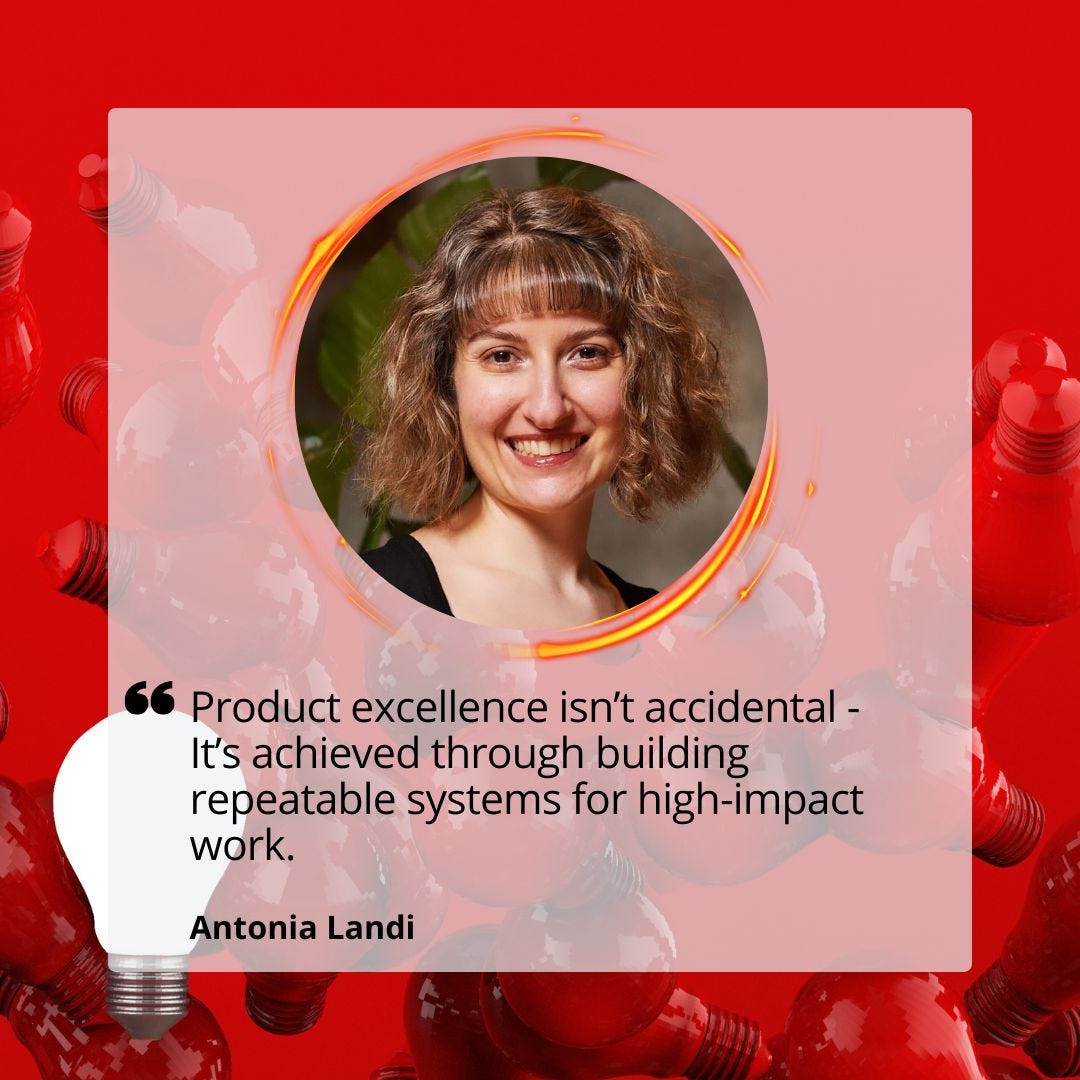
"Product excellence isn’t accidental - It’s achieved through building repeatable systems for high-impact work." - Antonia Landi
This 💡Product Circle⭕ Chat was run on the 6 May 2026 with Antonia Landi and hosted by Irene Liakos and Daniel Kinal.
Recording below👇🏼
But first a summary…
The Messy Middle
Antonia opened with an unusual introduction.
“When people do talks like these, they typically start by telling you all of the fantastic things about themselves,” she said. “But I like to do things a little bit differently. So, let me tell you about all of the things that I am not.”
She has a Scottish accent — spent a decade in Edinburgh, got her degree there, got her husband there, got her first cat there, got into tech there. But she’s not Scottish. She was born and raised in the German-speaking part of Switzerland.
But even there, she never felt like she quite fit in. Her family was Italian immigrants. Louder. More chaotic. Better food, she joked.
In Switzerland, she was always the Italian one. In Italy, she was the Swiss one.
“I was in between languages, I was in between cultures, and I never really fully belonged to any one of them.”
Her career mirrored that pattern. Started in quality assurance, but never fully technical enough to be a developer. Went into product, but never fully driven by commercials enough to double down on growth. Became a freelancer, but doesn’t want to run an agency.
“I realized that all of these things throughout my personal life and my career, for one reason or another, I was always kind of in the middle. And maybe in the messy middle.”
And that messy middle? That’s where ProductOps lives.
What ProductOps Actually Is
Before diving into the mistakes, Antonia defined what ProductOps actually is — because it means different things to different people, and sometimes doesn’t mean anything at all.
The Product Operations Manifesto defines it as “empowering product organisations to collectively, effectively, and efficiently drive the most meaningful outcomes for customers.”
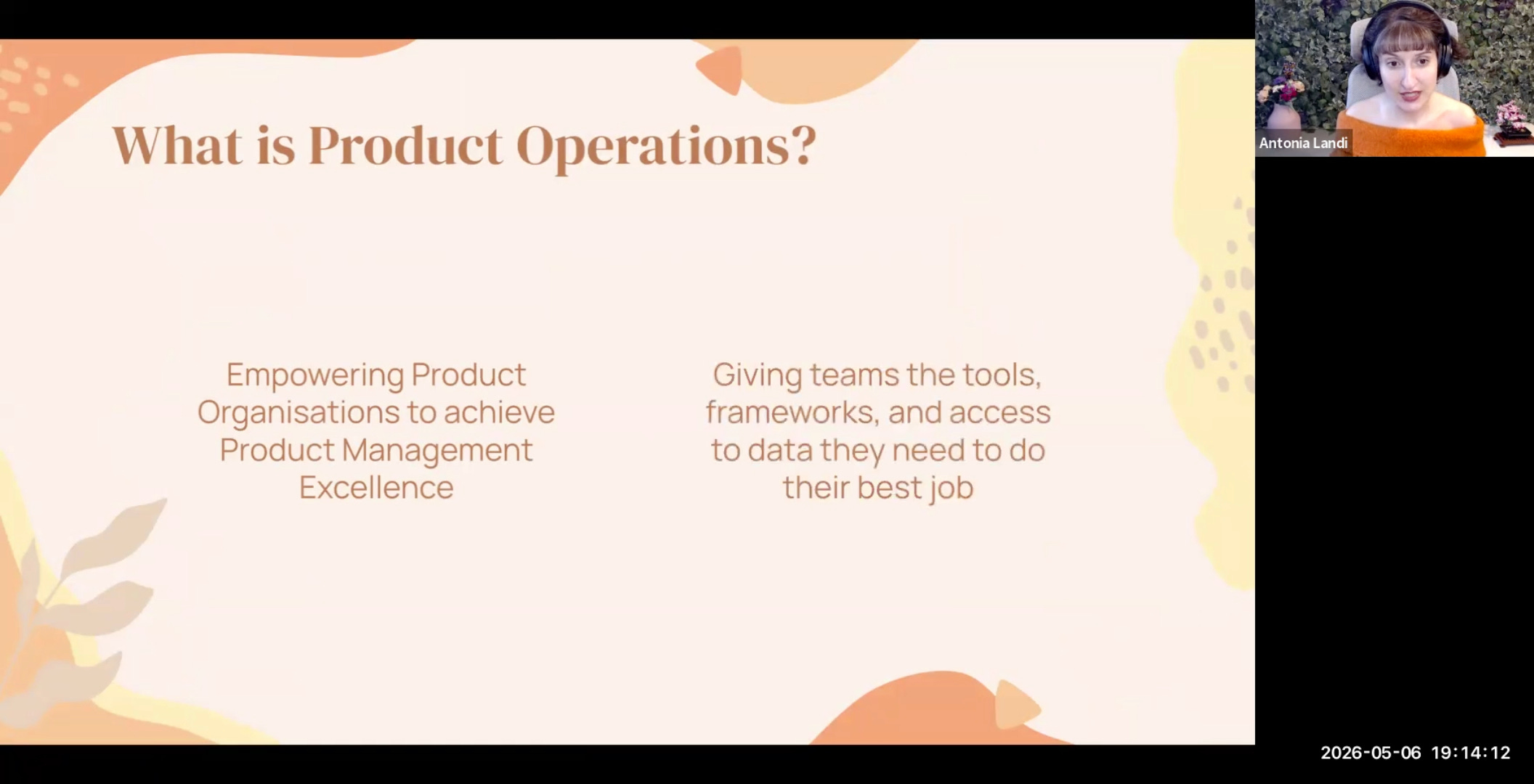
Antonia put it more simply: “Broadly speaking, I believe it is our mission to empower product organisations to achieve product management excellence. And we do this by giving teams the tools, frameworks, and access to data they need to do their best job.”
Or, in a nutshell: “We remove barriers to product excellence.”
But what those barriers look like is different from company to company. The pillars every ProductOps person contends with are tools (or systems — “everybody’s allergic to the word processes”), and data. But there are many more aspects of the job that some people do a lot of, some do a little of, and some don’t do at all.
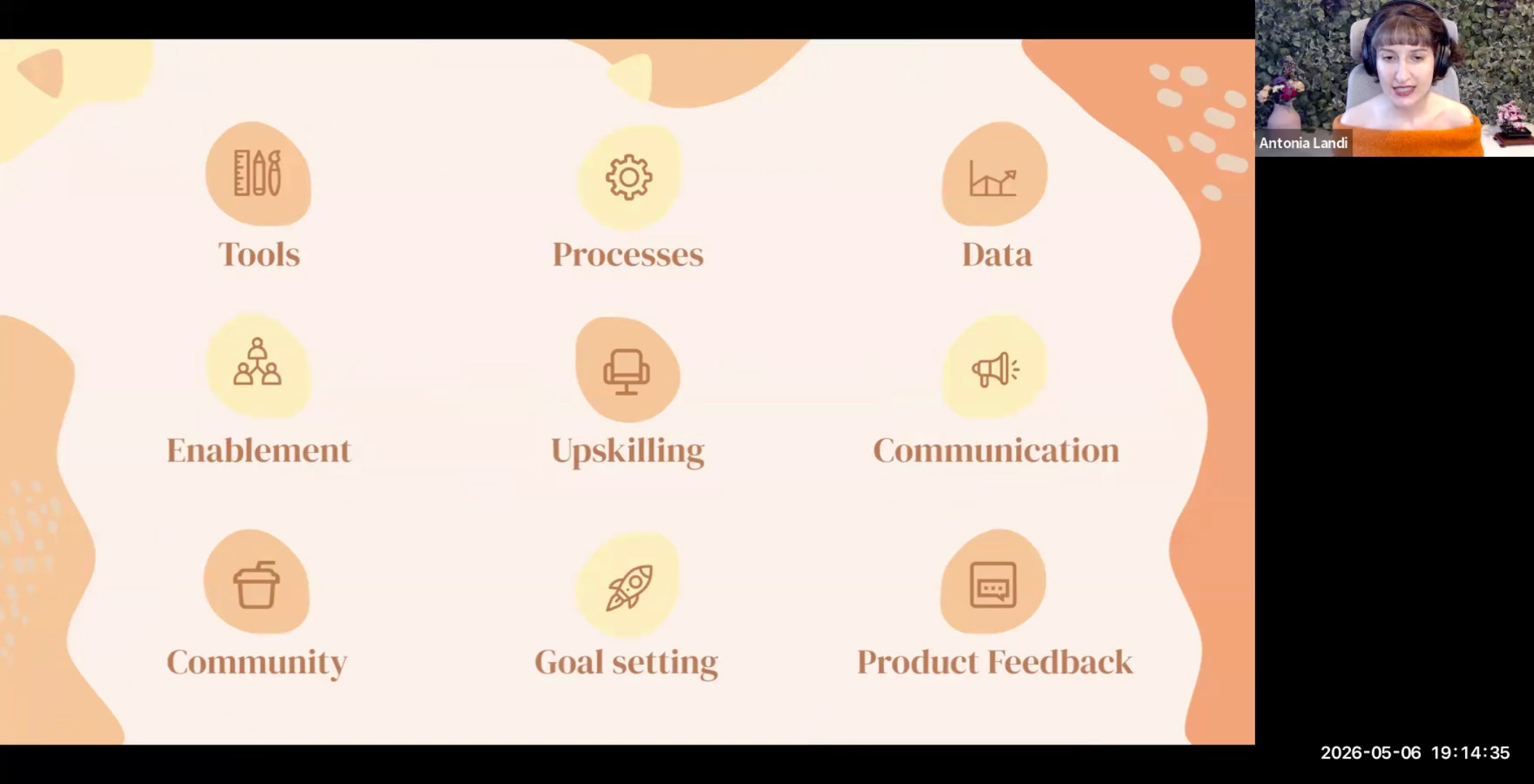
“We all have one common goal, and that is to create repeatable systems for high-impact work.”
The mission, since 2020? Fostering “a well-oiled machine, where all the parts seamlessly fit into one another. One that runs without friction. It runs repeatedly, it runs sustainably, and it can continuously get the job done. Without drama, without frustration, and without fuss.”
It’s not an easy mission. There are hundreds of ways to achieve it, and you often only know in retrospect whether you went down the right path.
“One of the things I always like to say is that we work with the biggest variable on Earth. And that is humans.”
Mistake #1: Assuming I wasn’t in Product Operations
Here’s the uncomfortable truth: arguing about whether ProductOps is valuable is pointless.
The work exists whether you name it or not. The question is whether you’re doing it strategically or letting it happen reactively in the gaps between “real” product work.
“All of these things we’ve seen are all things that have always had to happen in product organisations,” Antonia explained. “The existence of ProductOps as a discipline has not magically conjured up new tasks. All we are saying by making these things explicit is that these tasks are valuable, and that they should be done strategically.”
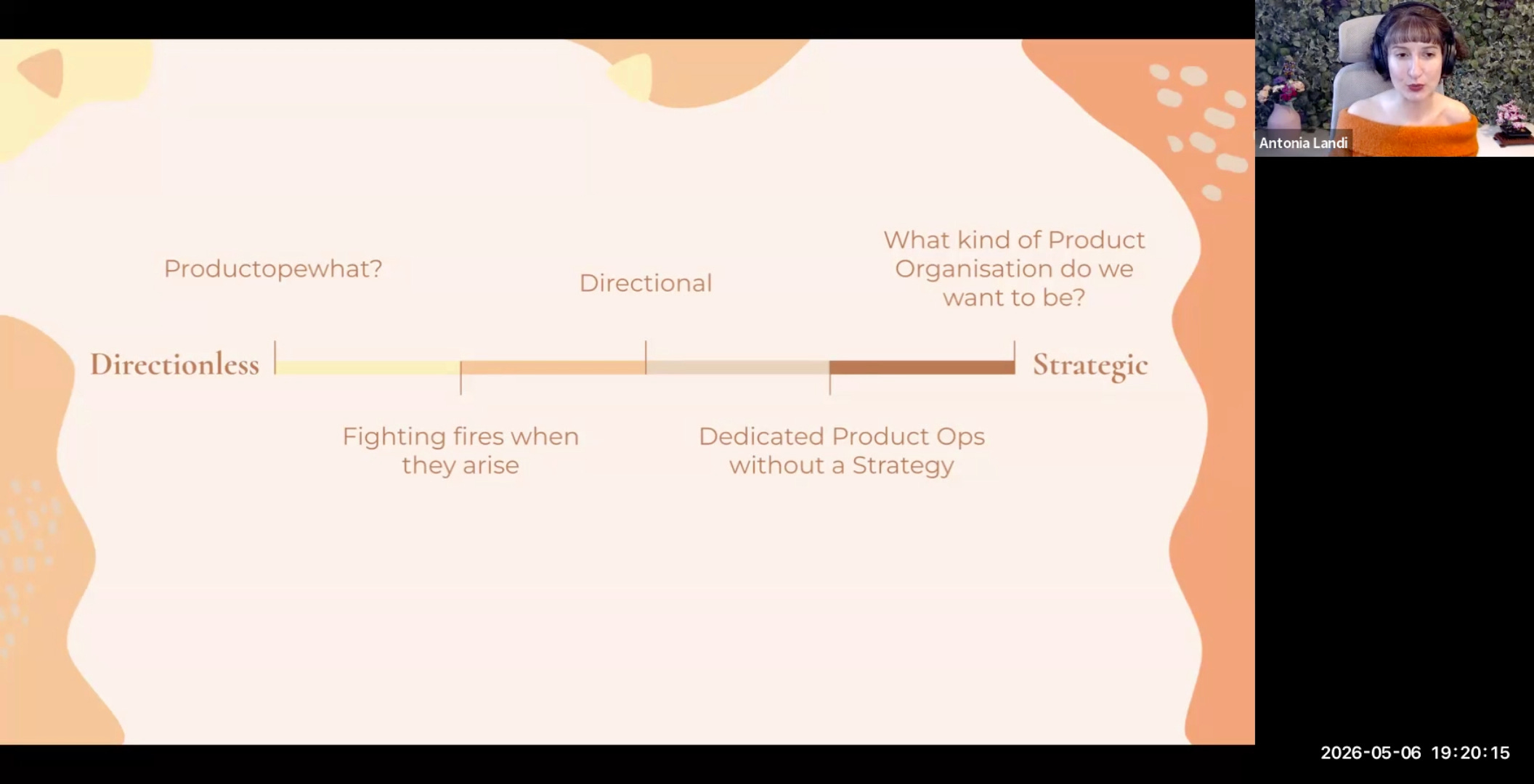
The danger of not recognising ProductOps work is twofold. First, it gets done inefficiently, squeezed in as an afterthought. Second, when organisations eventually hire for ProductOps, they often misunderstand the role entirely — treating it as admin support rather than operational excellence.
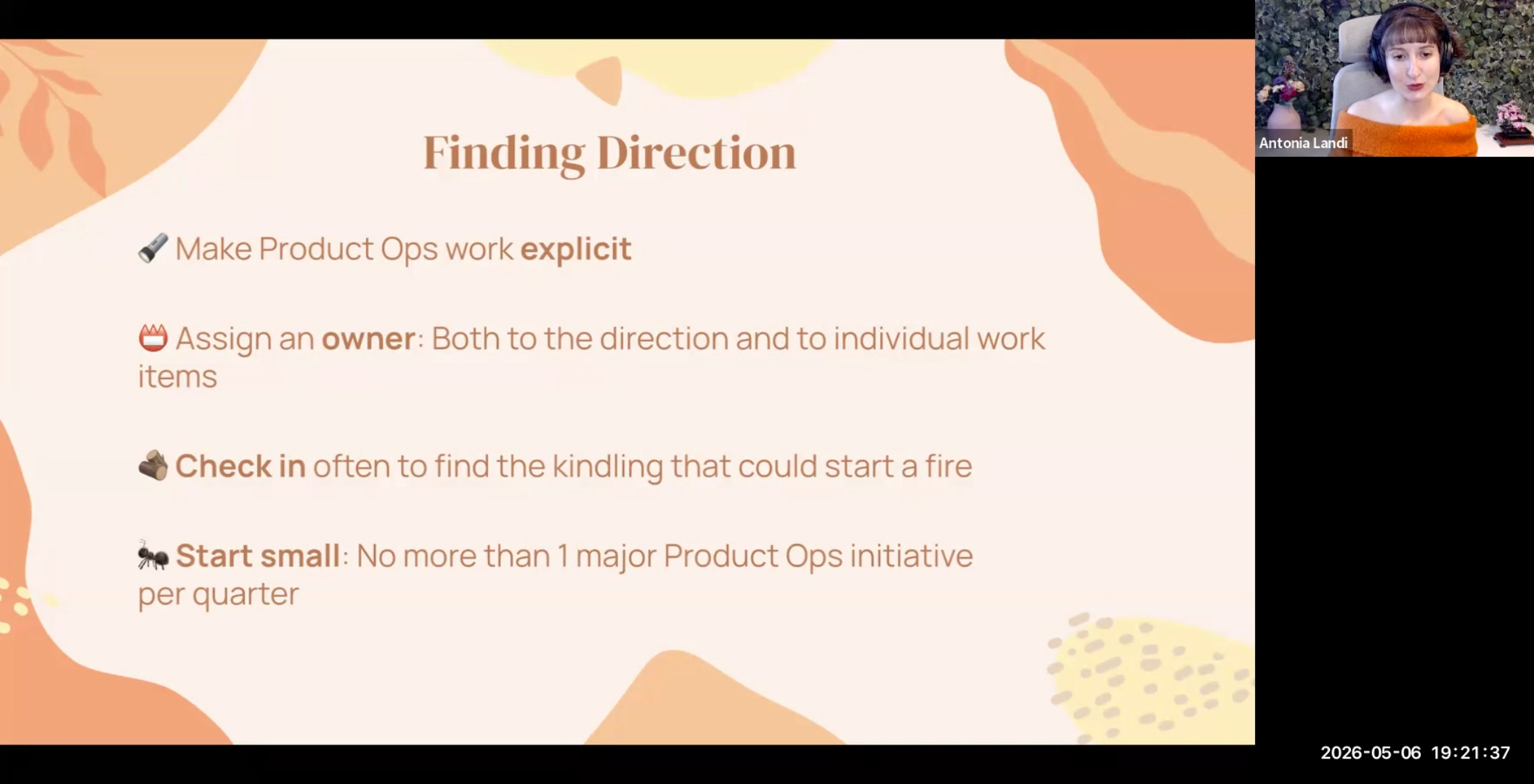
The fix: Make ProductOps work explicit, whether or not you have a dedicated role. Name it. Recognise it. Do it strategically. Because if you don’t have dedicated resources for this, Antonia was blunt: “It is up to you to unblock yourselves.”
Mistake #2: Assuming I didn’t need to show my thought process
Back to that disastrous newsletter meeting.
Antonia walked in with a solution. A massive communication strategy overhaul. To her, it was obvious. The problems were crystal clear — she could see them everywhere.
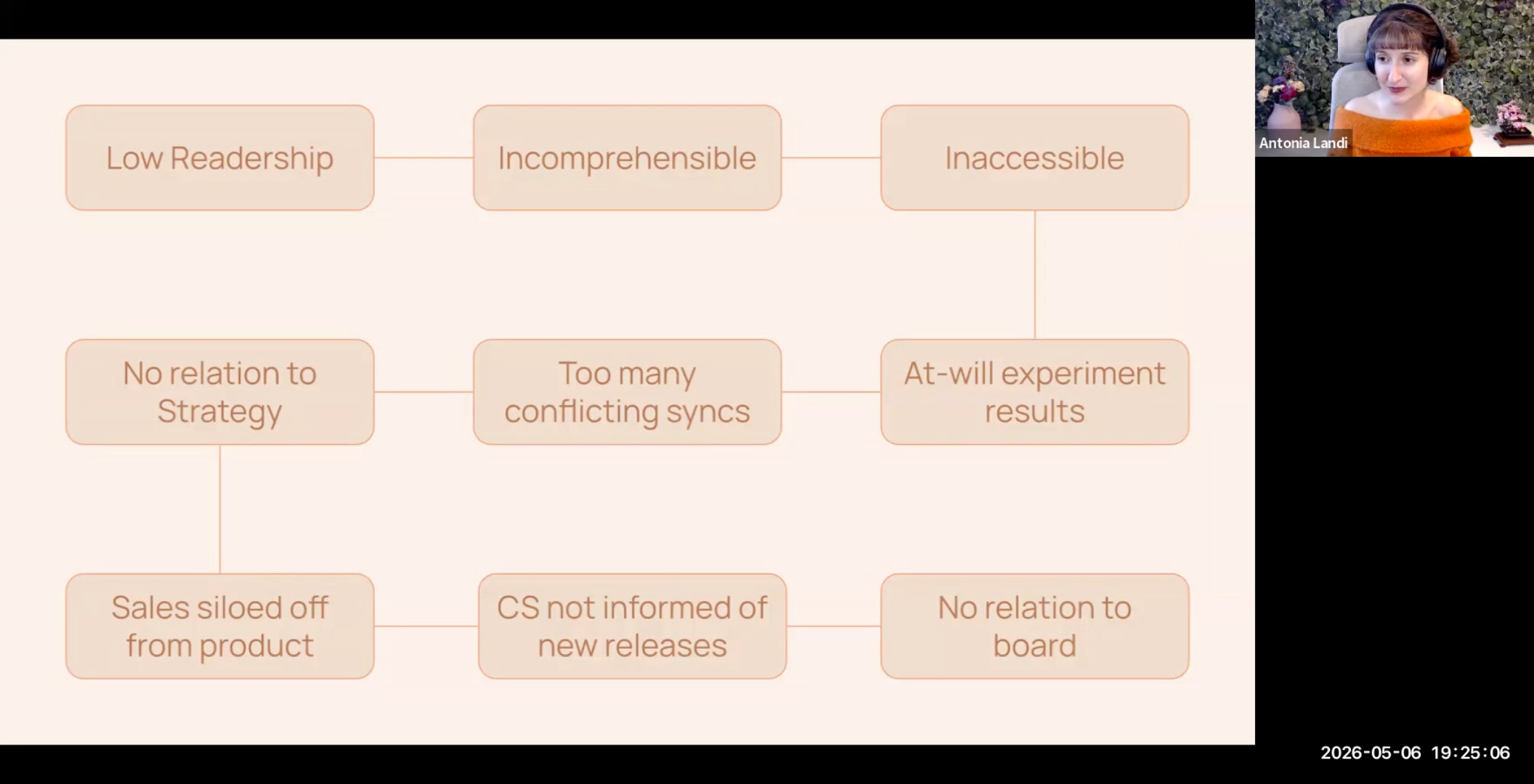
But to the people who lived in that system? To the team who’d gotten used to how things worked? It looked like the brand new leadership hire was telling them to throw everything out the window.
“I think this was one of the biggest mistakes I’ve ever done,” Antonia admitted. “Because undoing the fallout of that took way longer than taking them on that journey would have been to begin with.”
She lost time. Worse, she lost trust with the team.
“To me, the problems were crystal clear. I could see them everywhere, and I was like, how is nobody else seeing this? To me, it was so clear, it didn’t need to be explained. But to the people who lived in that system, who got used to that system, it was absolutely not clear.”
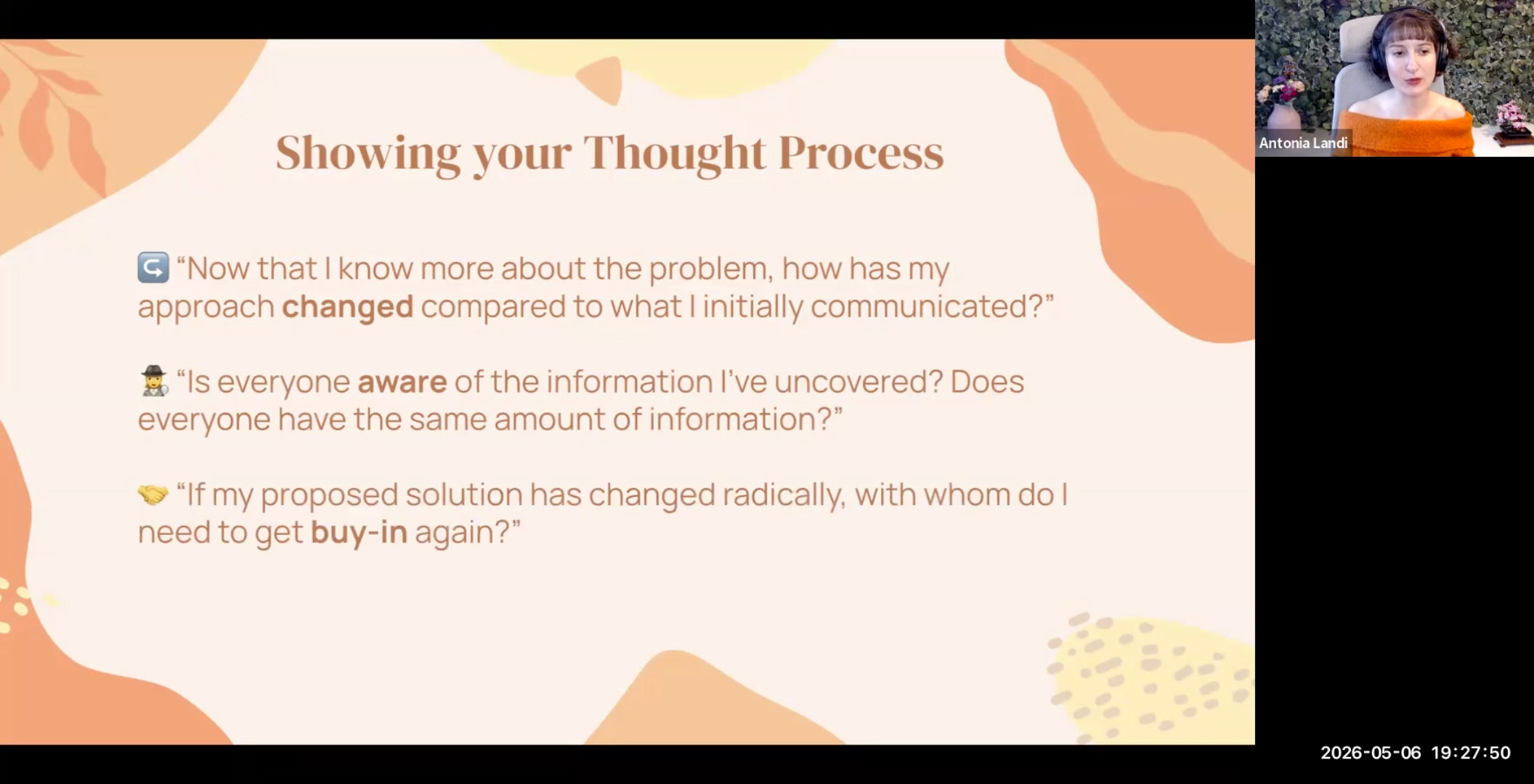
The lesson: show your working. ProductOps people often see patterns and solutions faster than others — that’s the skill. But jumping straight to the solution without bringing people along on the diagnosis journey triggers defensive responses, not collaborative problem-solving.
Ask yourself before proposing any change:
Now that I know more about the problem, how has my approach changed compared to what they initially communicated?
Is everyone aware of the information I’ve uncovered?
If my proposed solution has changed radically, with whom do I need to get buy-in again?
Antonia had buy-in to increase newsletter readership. She did not yet have buy-in to overhaul the entire communication strategy. That distinction matters.
Mistake #3: Assuming a New Tool is the Answer
“We need a roadmapping tool.”
This was the request Antonia received from a group CPO at a 3,500-person company. Most days, she would have said “okay, sure.” But she’d just come off a painful Miro implementation with hundreds of concurrent users.
So instead she asked: “Why?”
The longer they talked, the clearer it became. They didn’t have a tooling problem. They had a transparency problem.
“The thing about tooling is that it looks deceptively easy,” Antonia explained. “And B2B SaaS companies obviously have a vested interest in making you think that it’s something that’s very easy to do. However, it couldn’t be further from the truth.”
What People Think Tooling Implementation Looks Like:
Identify problem
Buy tool subscription
???
Success!
What Tooling Implementation Actually Entails:
Identify and validate the problem
Identify and prove/disprove possible solution hypotheses (buying a tool is only ONE hypothesis)
Select tool based on success criteria
Purchase subscription
Learn administration
Set up the tool
Share licences
Educate people on usage
Integrate with existing tool stack
Maintain the tool, information, and licences “forever into infinity”
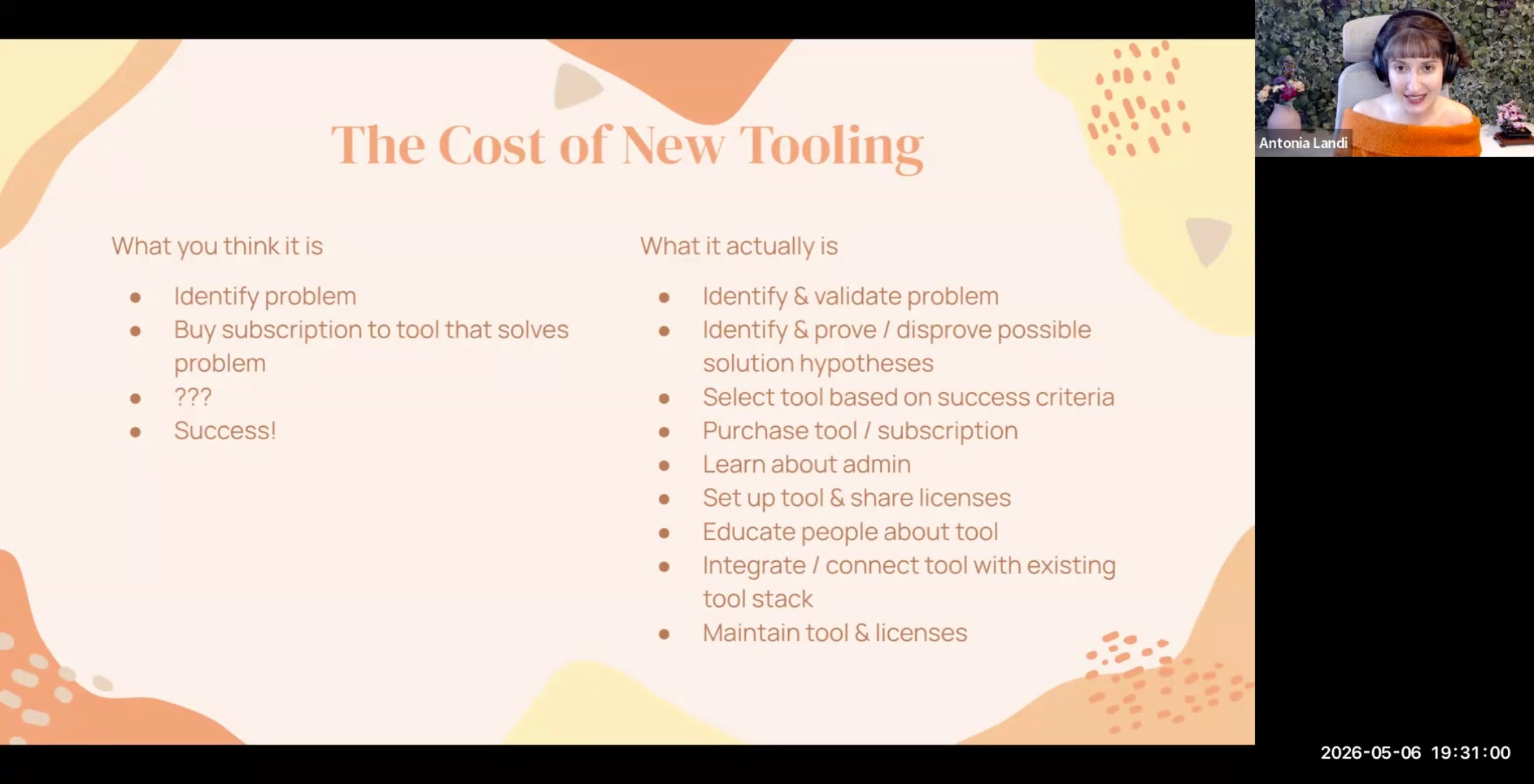
“Please identify your actual needs before you start going down that road,” Antonia urged.
Ask yourself:
If I wasn’t allowed to purchase a new tool, how else would I solve this?
Do I need to buy a tool that solves my problem to 65%, or can I make a tool with what I already have available? (Sometimes your best tool is a spreadsheet that works really well.)
What is the quickest and cheapest way to test that solution?
If a tool does tick all the boxes, who does what? Because a successful tooling implementation has many moving parts.
This advice is “stunningly applicable to AI tooling as well,” Antonia noted — a timely reminder as organisations rush to implement AI solutions without first validating whether AI is solving the right problem.
Mistake #4: Assuming Everyone Cares Equally
“It might sound a little weird for me to talk about people’s feelings when we’re talking about operations,” Antonia acknowledged. “But product operations is fundamentally about change.”
You’re constantly asking people to:
Stop doing something they’re comfortable with
Start doing something they might not be good at yet
Do something differently than they’ve done their entire career
And it becomes increasingly difficult if people don’t see the value in what you do — especially if they worry the change is for the worse.
Antonia painted a vivid picture of the different voices in the room during any ProductOps change initiative:
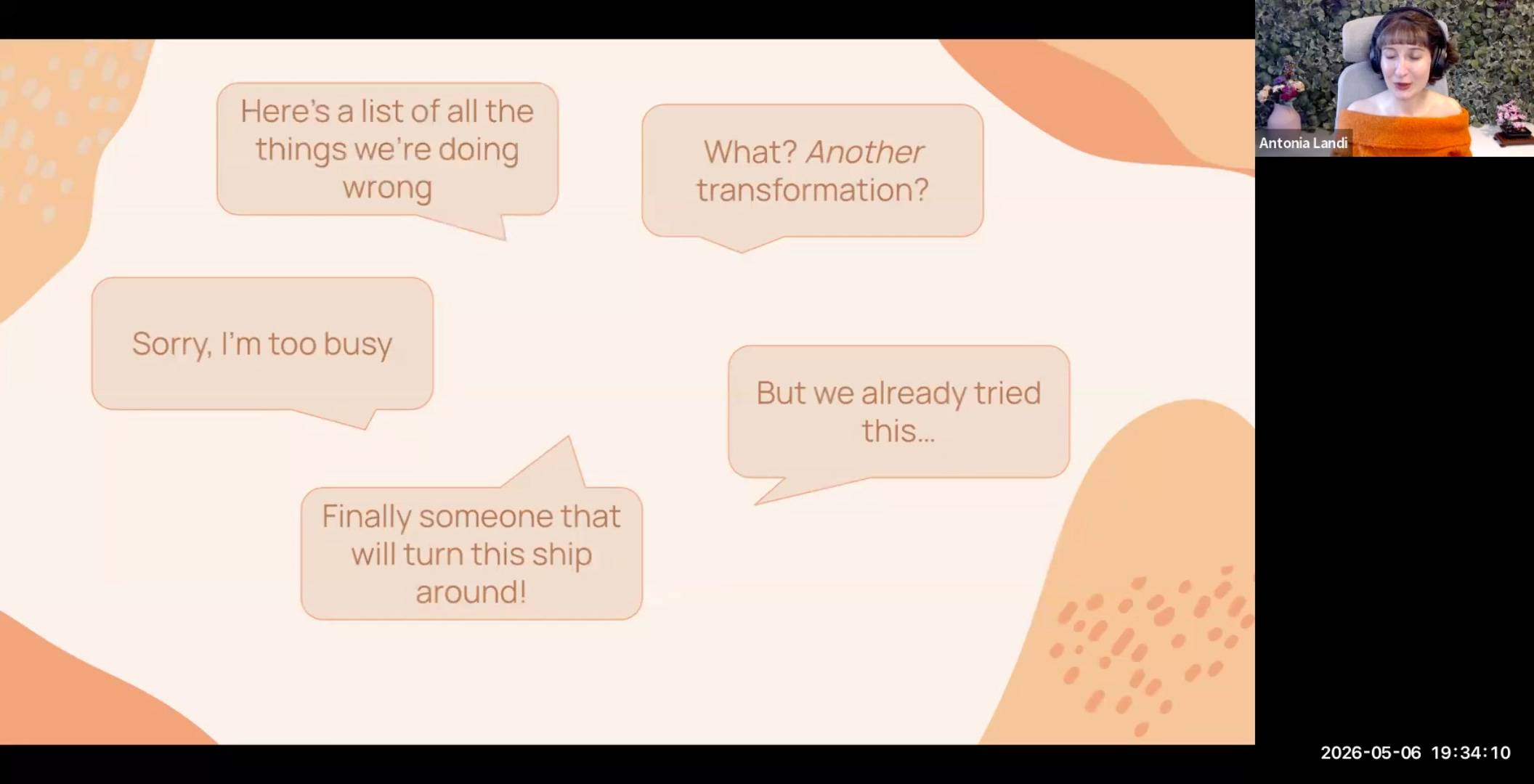
The transformation-fatigued: “What? Another transformation? Come on, we’ve already had three of these. First agile, then product, now AI.”
The sceptic: “We already tried this, and it didn’t work.”
The super enthusiast: “Finally somebody who will turn this ship around!”
The overloaded: “Sorry, I’m too busy, I literally do not have time to deal with this.”
The list-maker: “Hey, here’s a list of all the things we’re doing wrong. Enjoy!”
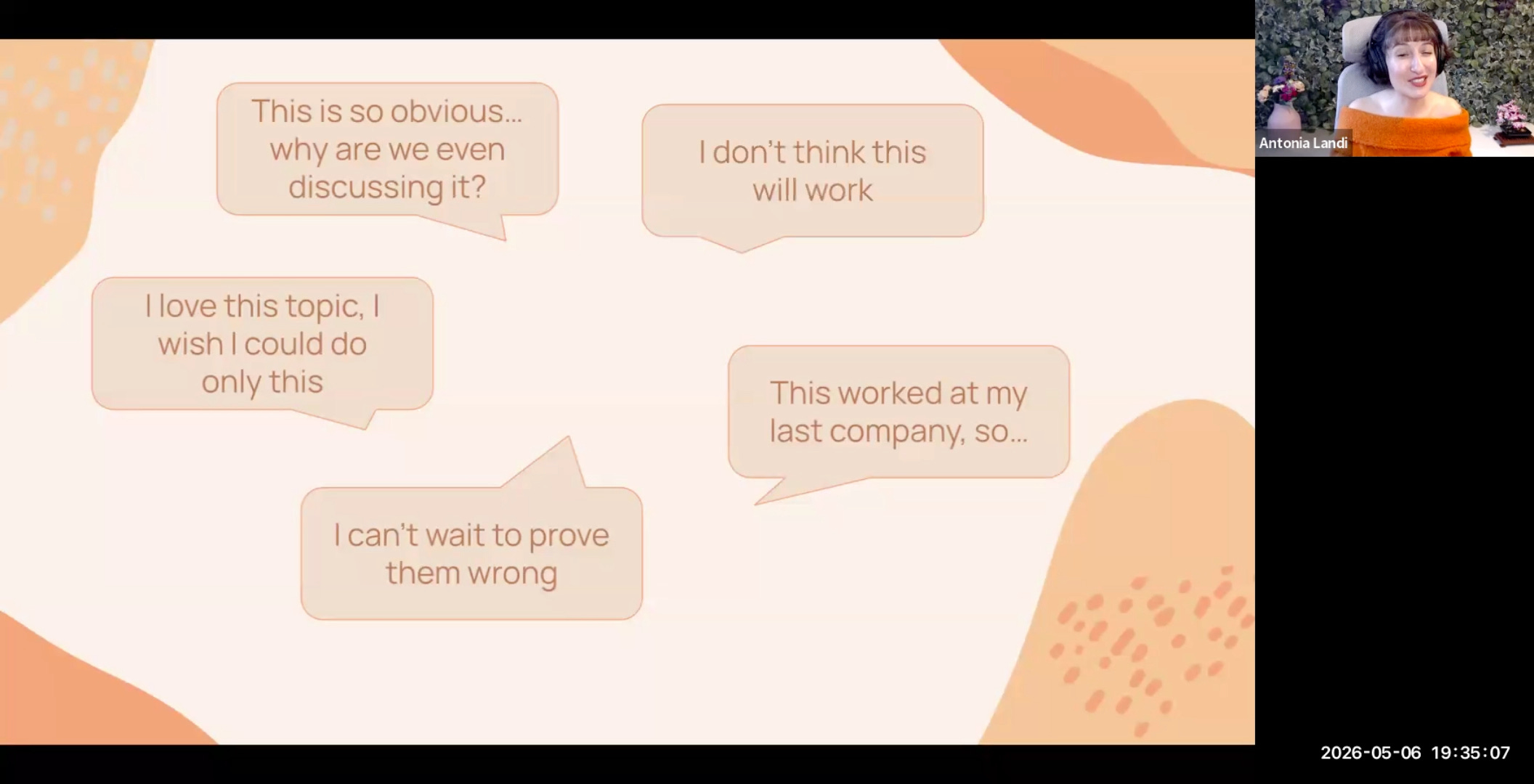
While navigating all these voices, you also have to be mindful of your own biases:
“This is so obvious, why are we even discussing it?” (Antonia with the newsletter)
“This worked at my last company, so let’s just do it.”
“I cannot wait to prove them wrong on this one.”
“No two organisations are the same,” Antonia reminded us. “No two product leaders are the same, no two product managers have had the same experience, no two product ops implementations are the same.”
Pushback is real. It happens often. It’s part of the daily work.
But when you experience pushback, ask yourself: What got us here?
“Resistance never comes out of the blue,” Antonia said. “It might predate you, it might be about something that person experienced three companies ago, but it’s never a non-sequitur. People don’t wake up one day deciding to be difficult.”
The fix requires three things:
Gather context. Can I learn more about why this person might be acting the way they’re acting?
Give reassurance. What worries do they have, and how can I address them? (ProductOps often makes people feel like they’re losing agency — if you can address that explicitly, you can make progress.)
Assess priority. How important is ProductOps work to the organisation, and what happens if this pushback continues? Because sometimes, it’s just not the right time for change.
“In those moments,” Antonia concluded, “it’s crucial to just show up like a human.”
Mistake #5: Assuming People Are Ready for the ProductOps Conversation
Antonia’s final mistake is one she “consciously decided to make very early in my ProductOps career, and one that I will gladly keep on making.”
“I’m going to assume that you’re ready to have this conversation,” she told the Product Circle Chat audience. “Even if you’re not quite sure yet.”
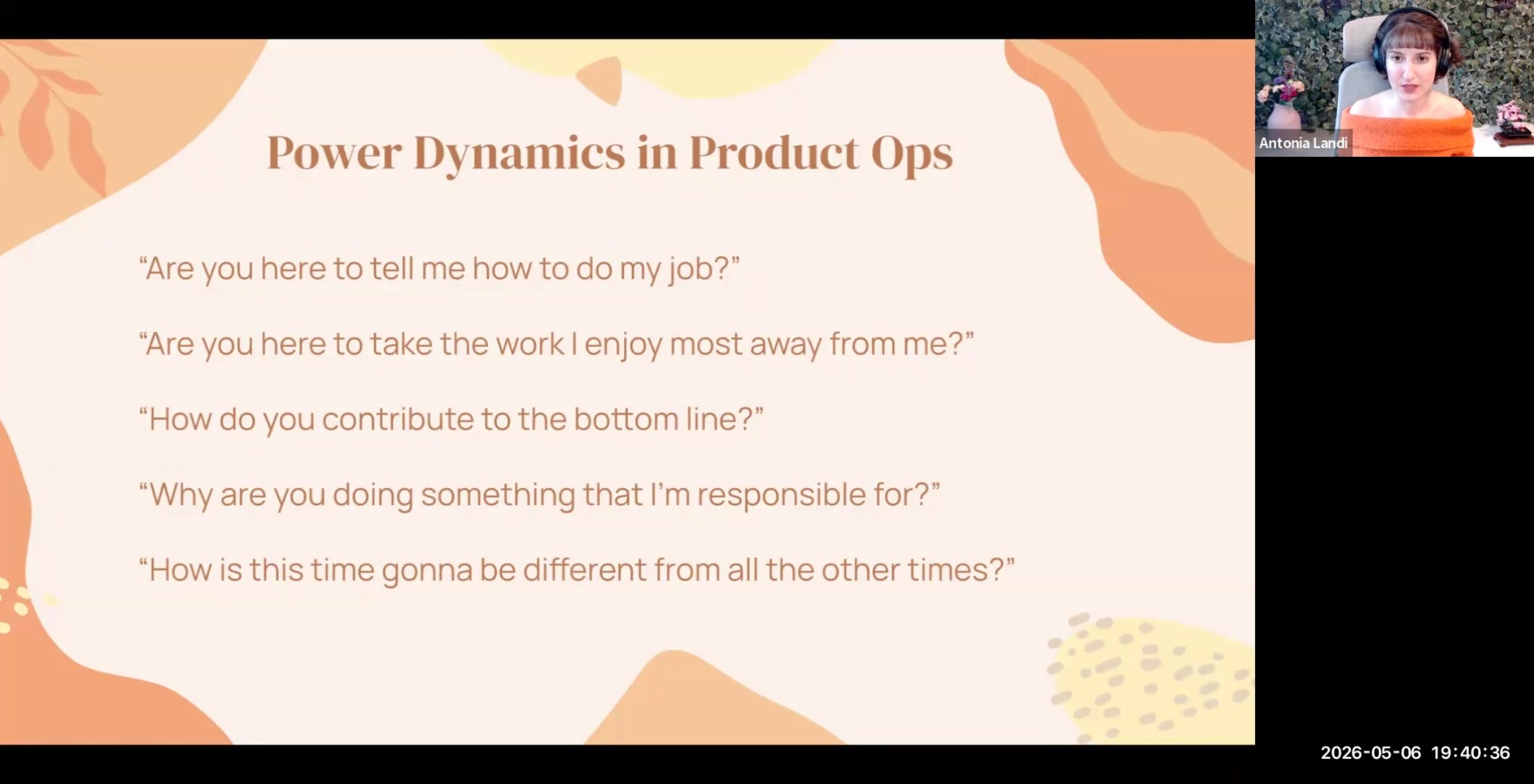
ProductOps is still misunderstood. The name itself — “operations” — carries baggage that suggests admin work, tactical execution, or process for process’s sake. Many organisations still don’t understand what ProductOps can do. Many product managers haven’t experienced well-implemented ProductOps.
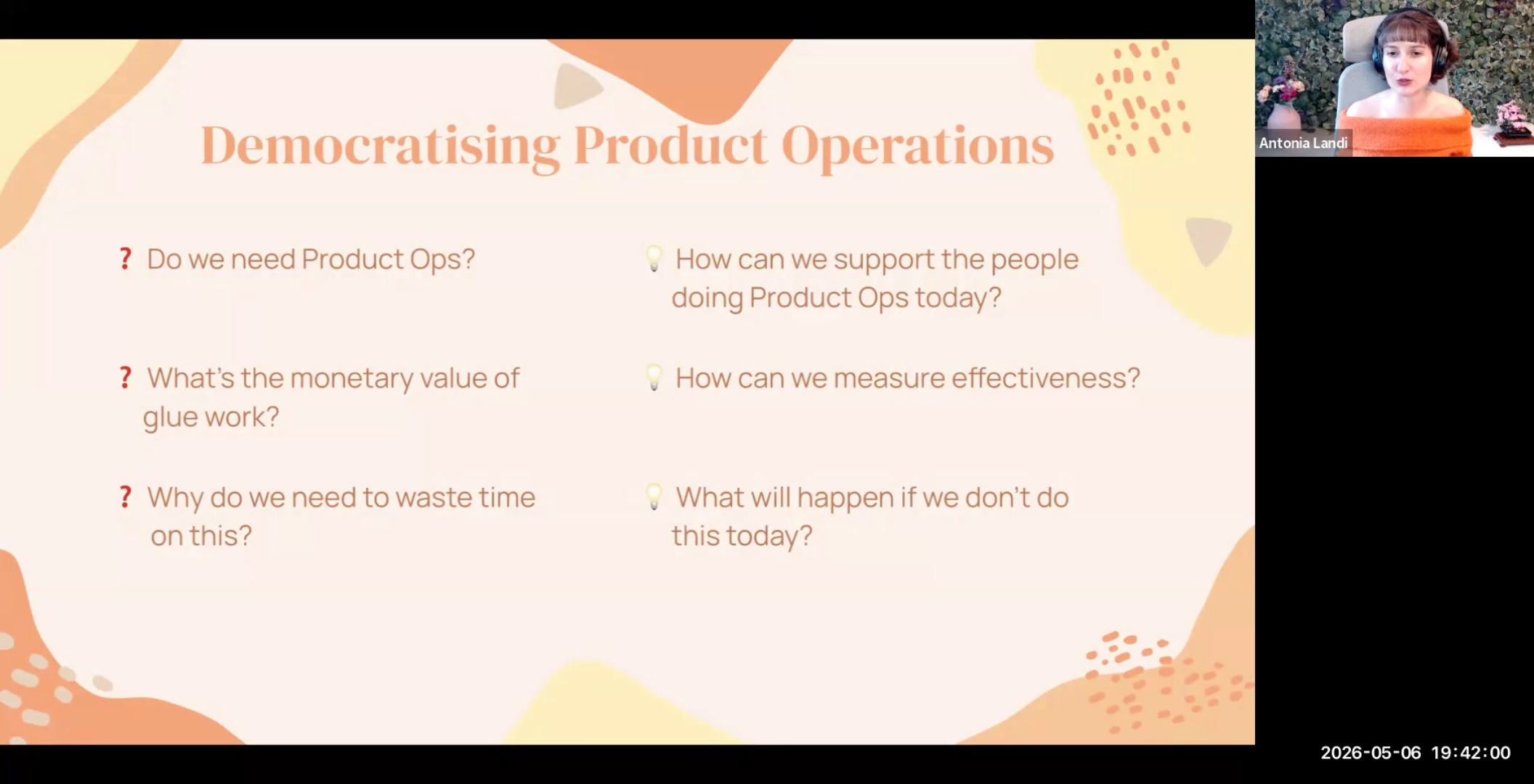
But Antonia chooses to have the conversation anyway, again and again, because “the message is starting to land, definitely more than it did a few years ago.”
“Sometimes I wonder, is our name doing us a disservice? Because we’ve got operations in the name, and that’s just, you know, like, yeah, we’re just doing the admin stuff, we’re making sure the Jira workflow works. But there’s so much more that this function can do. It’s really such a force multiplier.”
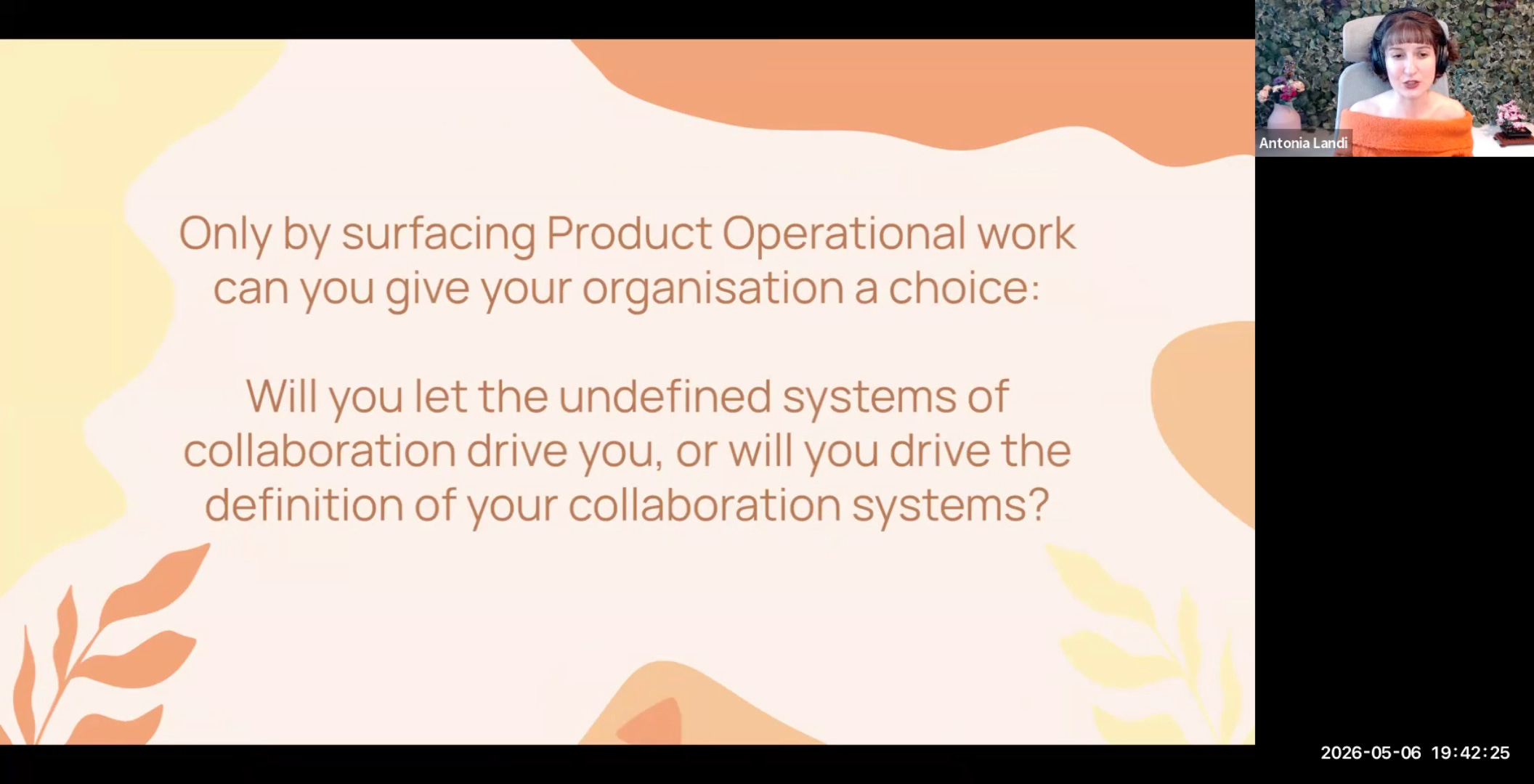
As Daniel Kinal (the co-host) observed: ProductOps is “understood even less than product management.”
How to Measure ProductOps Success
Kurt, a ProductOps lead, asked the question on everyone’s mind: how do we measure success?
Antonia’s answer: measure on two different axes.
Long-term goals (2-3 outcomes you’re shooting for):
Better predictability in delivery
Learning more about customers, or learning better about customers
Faster decision-making
Individual work items (the things you do today, the changes you introduce to get there):
For example, if you want to increase predictability, measure how often you are off, how much longer it takes to deliver something you said you would deliver. Then you might introduce a two-phase estimation system — rough estimates at the beginning of the sprint, then revised estimates as you progress. Then measure whether that made you more predictable.
Rather than going for product ops metrics, Product Ops is so specific to the organisation, I think it’s really about defining where do you as a company want to go, and what are you, as a product ops leader, there to facilitate, and how can you measure that that behavioural change is happening?
The key trade-off: “I would much rather you have to find an imperfect signal. Then the absolutely best measurement in the world, but it took you 14 months to get there, because you’re just flying blind if you do that.”
Be explicit about assumptions. If you measure how often PMs speak to customers, the assumption is that by speaking to more customers, you build better products or do it with less waste. “That’s an assumption. But broadly speaking, this is something that we as an industry have identified to be correct.”
So it’s making that trade-off between being explicit about the assumptions our metrics have, but at the same time, not letting that block us from measuring.
Watch the video to learn more 👇
Product Circle Chat - Topic
Topic: 5 Product Ops Mistakes That Kill Momentum (and How to Fix Them)
Everyone wants the outcomes of Product Operations. Better alignment, clearer decision-making, smoother delivery, less chaos.
But Product Ops rarely fails because of frameworks or tools.
It fails because of the assumptions we make.
In this candid, experience-led session, Antonia Landi shares five hard-earned mistakes she made building Product Ops inside real organisations, the subtle traps that quietly stall momentum and erode trust.
✨From thinking you’re not doing Product Ops (when you already are)…
✨to over-investing in tooling…
✨to underestimating the human side of change…
This session is designed to help you course-correct before momentum takes a hit. Whether you’re formalising a Product Ops function or trying to make “how we work” actually stick without a mandate.
What we’ll cover
✅ The 5 mistakes that quietly derail Product Ops (even in well-intentioned teams)
✅ How to spot “Product Ops theatre” vs meaningful operational impact
✅ When tools help — and when they become an expensive distraction
✅ The real (human) change work most teams underestimate
✅ Practical course-corrections you can apply immediately
Product Circle Chat - Video
Product Circle Chat - Speaker
Antonia Landi is a Product Operations Coach & Consultant and a leading authority in Product Operations, helping organisations turn great ideas into world-class products through strong operating models and repeatable systems for high-impact work.
After starting her career in the games industry, Antonia went on to build and scale Product Operations in companies across Europe and now partners with global organisations to design operating models, make strategy actionable, and drive data-informed decision-making.
A prolific thought leader, Antonia’s insights have been featured in LeadDev, Mind the Product, and Product-Led Alliance. She regularly speaks on industry stages and shares her thinking through her writing and community work. Originally from Switzerland with Italian roots, she now calls Berlin home and when she’s not transforming how teams operate, you’ll find her making jam, exploring new cities, or indulging her love of fashion.
Where to find Antonia:
Product Circle hosts regular sessions with product leaders exploring the challenges and opportunities facing modern product management. Visit The Product Venn on Substack for summaries and insights from past sessions, and follow Product Circle on Luma for upcoming chats.
TL;DR
ProductOps exists whether you name it or not. The work has always had to happen. Make it explicit and do it strategically.
Show your working, not just your solutions. Jumping straight to the answer without taking people on the diagnosis journey kills trust.
Tools are hypotheses, not solutions. Identify actual needs before buying. Sometimes a spreadsheet that works really well is your best tool.
Resistance has a story. People don’t wake up deciding to be difficult. Understand what got them here. Show up like a human.
Measure with imperfect signals rather than flying blind. Better to have an imperfect measurement today than the perfect one in 14 months.
Product Circle Chat - Q&A
❓ How do I get involved?
1. Subscribe to the Product Circle Chat Calendar on Luma and get notified of every 💡 Product Circle ⭕ Chat event
2.Register & Show up - Register to the Product Circle Chat event, block your calendar out and come to the next Chat 📅
3. Share - bring a friend or two who wants to talk all things Product 👯♂️👯♀️
4. Volunteer - volunteer to host or present at one of the future Product Circle Chats 🙋♀️. Drop me an email at irene@phronesisadvisory.com
❓ Will there be more sessions?
Yes. Fortnightly. Every second week.
❓ What if I can’t make the next session or don’t want to miss the next Product Circle chat invite?
Really want to come to the session but 😭 can’t make this specific 💡 Product Circle ⭕ Chat?
📆 Get an invite directly into your inbox
👉 Subscribe to the Product Circle Chat Calendar on Luma and get notified of every 💡 Product Circle ⭕ Chat event
💪 We’ve got you!
❓ Still have Questions?
Talk to me. Send me an email at irene@phronesisadvisory.com
Product Management is Changing
Most books (and courses) haven’t caught up.
I’m writing one that has.
After 25 years in product, and writing the ICAgile certified Product Management course that trains Product Managers globally, I’m finishing a book that takes you from the foundations of product thinking all the way through to senior leadership. With an honest look at what AI changes at every stage of the work. Having met over 100 global product leaders, thinkers and speakers through running 💡 Product Circle ⭕ Chat over the last four years, I have seen the changes first hand.
This book covers how to create value as a Product Manager, how to capture it (commercials, pricing, business cases, and actually understanding money), how to scale it (sustainable growth with customers converting customers), how to protect it (product ethics, sustainability. The things most organisations skip), and how to transform an organisation so it can keep doing all of this, not just once, but continuously.
It’s the book I would have wanted at the start. And the one I needed ten years in.
Upgrade to a Paid Subscriber at The Product Venn to read early chapters as they’re released. Or join the waitlist to be first to know when the book and training courses are available.